Arrr! Your Treasure Map to Freedom!

Arr! Treasure! What good is knowing about a treasure without the map! We have discussed the why of possibly pursuing the path of financial freedom in the 1st post, what is financial freedom in the 2nd post. Now let’s talk about actionable steps that we can take to realize this dream.
Panna, K. (2012, Oct 06). Treasure Map. Retrieved from https://www.deviantart.com/kaffepanna/art/treasure-map-330963415

The types of people can be classified into 4 quadrants as illustrated in the figure below.
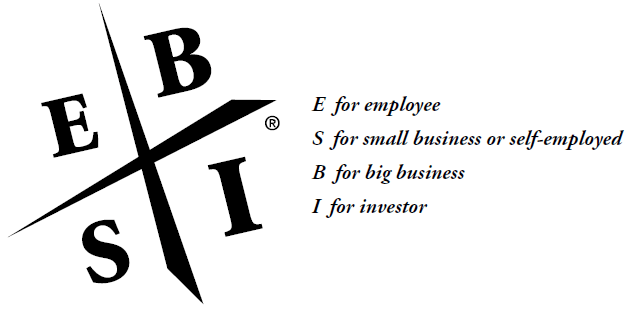
Kiyosaki, R. T. (2011). Cashflow Quadrant. [Diagram]. Retrieved from Rich Dad’s Cashflow Quadrant. Scottsdale, Arizona, USA: Plata Publishing, LLC.

On the left side of the quadrant, there are the ‘E’ and ‘S’ people which stands for Employees and Self-employed. Employees work for others, while self-employed are people who work for themselves – they are a one-man business. On the right side of the quadrant, there are the ‘B’ and ‘I’ people which stands for Business Owners and Investors. Business owners employ people to work for them, while investors have large financial capital to invest and have their money “work for them” to generate more income. [image] The path to financial freedom is to work towards becoming people in the right quadrant – business owners and/or investors (Kiyosaki, Rich Dad’s Cashflow Quadrant, 2011, p. 13).

Realistically, many of us who graduate from college into the workforce will be on the left side of the quadrant as employees, simply because we will not have enough capital to be an investor or a business owner and that is fine.

The important thing here is to have a game plan to reach the right quadrant. Recall that the goal of achieving financial freedom is purchasing more assets that put money into your pocket so that your passive income will exceed your expenses.

In my opinion, we have two possible pathways to reaching the right quadrant, when we enter into the workforce as employees

Employee Pathway

Be the best you can be, specialize and do whatever it takes in your field to attract a high income, because of the value you bring to the employer. In this way, you can purchase more income-generating assets at a faster rate to reach financial freedom as an investor on the right quadrant.

Entrepreneurial Pathway

Many entrepreneurs or freelancers start as employees as well. The key difference here is that as you work, you are focused on learning the skills needed to start your own business. Examples of such skills may be sales, networking, negotiating, etc.

Once you have sufficient experience and decide to take the leap of faith to start your own business, you would most probably start as a self-employed because of your limited capital. The key here is to create systems so that when your revenue grows and you can afford to hire people, there is a system in place and it can run without you. By doing that, you are transiting to become the ‘B’ person – business owner in the right quadrant. An example of such system creation is to draft up the various “hats” that you wore as a start-up (sales, marketing, financial accounting, inventory management, etc.), into clear and detailed job descriptions and procedures.

Assets to purchase come in many forms. They can be businesses, stocks, bonds, rental properties that you collect rent on, royalties from intellectual properties such as art, music, book or patents. In essence, anything that generates passive income for the owner is an asset.

I hope that these posts have inspired you to consider an alternate pathway to life. Which pathway do you think you would take and why? I would love to hear your opinions! Please leave your comments below.

ps. If you found this valuable, please share it with others! 🙂

References:

Kiyosaki, R. T. (2011). Rich Dad’s Cashflow Quadrant. Scottsdale, Arizona, USA: Plata Publishing, LLC.

The Curious Case of Financial Freedom

What exactly is financial freedom? It is being free financially, not having to worry about whether you can pay the bills, or what happens if I am fired.

Financial freedom is achieved when your passive income is equal or more than enough to cover your expenses. And what exactly is passive income? Income can be classified into active and passive. First let us discuss active income, which is the income earned by doing work. Getting paid for working at Tim Horton’s, or the supermarket are examples of active income. If you do not go to work, you do not get paid. You have to actively work to receive your income, hence the name active income.

Passive income, on the other hand, is income that is earned with minimal effort or no work at all. You could be travelling the world, bumming at the beach, sleeping in when you are sick and you would still get paid! How is this possible?!

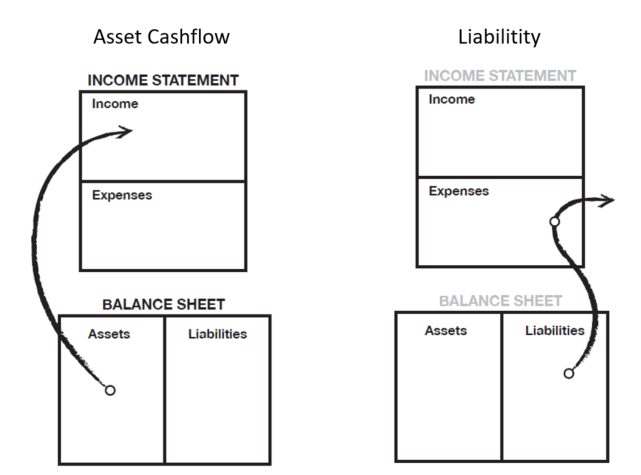
It all comes down to how much assets you have versus liabilities. Robert Kiyosaki’s concept of assets and liabilities differs from conventional definitions. Anything that puts money into your pocket is an asset and anything that takes money from you is a liability. See the diagram and video below. A car that you purchased would be considered an asset in conventional finance. However, if we look at it based on Robert Kiyosaki’s definition, the car would only be an asset if it was rented out and you received income from it. If the car was purchased for regular commuting and we had to pay for gas and maintenance, money is “flowing” out from our pockets and should be considered a liability (Kiyosaki, Rich Dad Poor Dad, 2011, p. 46).

Kiyosaki, R. T. (2011). Cashflow of Assets and Liabilities. [Diagram]. Retrieved from Rich Dad Poor Dad. Scottsdale, Arizona, USA: Plata Publishing, LLC.

With this understanding of assets and liabilities, the goal of financial freedom is to purchase assets that will generate enough passive income so that it is more or equal to one’s expenses.

You are truly financially free when you do not ever have to work again if you choose not to and still receive enough income from your assets such as a rental property or dividends from stocks, to cover your expenses.

Do you or your parents have more assets or liabilities? what are some ways that you think you could turn your liabilities into assets? Rent your unsold textbooks, half of your room, car out? I would love to hear from you. Please leave your comments below.

ps. If you found this valuable, please share it with others! 🙂

References:

Kiyosaki, R. T. (2011). Rich Dad Poor Dad. Scottsdale, Arizona, USA: Plata Publishing, LLC.

Beat the Rat Race!

Two Roads Diverged In A Wood And I – I Took The One Less Traveled By, And That Has Made All The Difference

— Robert Frost.

Rushing from class to class, trying to understand what that professor is mumbling about, preparing for exams, meeting deadlines and juggling all these with a part-time job to support yourself through college. Most students can identify with this. Striving to achieve good grades and in the midst of it all, wishing for graduation sooner rather than later to be done with all these stress and hectic school life. But often, graduates find themselves disillusioned after entering the workforce.

Jovin, S. (2009, Nov 30). Busy College Student. Retrieved from http://scarletphoto.blogspot.com/2009/11/busy-college-student.html

They have schedules that are longer than school hours, do not have as much flexibility as to when they were students. If they thought dealing with unenthusiastic teammates on a project with a looming deadline is bad, they have not seen the working world where they have to deal with nasty bosses who determines your “future”(bonuses, leave approvals, promotions) and backstabbing, pretentious colleagues. Worst of all, unlike school with graduation as the end to look forward to, there is no end in sight for workers! Work-life is perpetual and you have to keep going at it to survive. Please do not get me wrong, not all work experiences are like that but a majority of workers do not enjoy their work and are disengaged (Clifton, 2017)

Dragging your feet to work every day, dealing with office politics, tirelessly competing to get ahead and wishing to call it quits but not being able to because you have bills to pay, loans to repay, and in time possibly a family to feed. This is the Rat Race. It is so-called because workers find themselves caught in an endless cycle of working, eating and sleeping, repeating it continuously, like the mouse or hamster running on the wheel with no end. The future sounds pretty gloomy and demoralizing, doesn’t it? It doesn’t have to be this way! There is an alternative pathway to traditional work that most people do. A less trodden path, a path that requires more sacrifices and more hard work. However, this path that is less taken will lead you to freedom – Freedom from working for other people’s dreams, endlessly competing with backstabbing colleagues and working for a paycheck, freedom to pursue your dreams, do things that matter to you in life, and spend more time with people you love!

This alternate pathway is the pathway to financial freedom or financial independence. What do you all think about this concept? What is worth it to you, to pursue the less trodden pathway of financial freedom? For me, it is having the time to spend it with my family and travel the world. I would love to hear from you. Leave me comments below.

ps. If you found this valuable, please share it with others! 🙂

References:

Clifton, J. (2017, Jun 13). The World’s Broken Workplace. Retrieved from Gallup: https://news.gallup.com/opinion/chairman/212045/world-broken-workplace.aspx?g_source=position1&g_medium=related&g_campaign=tiles

Design a site like this with WordPress.com
Get started